26 October 2015

My First BFF . . .

. . . That's Black-footed Ferret, of course!  Last night I joined the Arizona Game and Fish Department on a spotlighting survey for Black-footed Ferrets.  This is the only ferret native to the Americas, and although it was once widespread in the inland western United States, it declined dramatically following US government efforts in the early 1900s to eradicate prairie dogs, its main food source.  In 1979 the Black-footed Ferret was declared extinct, but in 1981 a small population was found in Wyoming.  That population, too, declined rapidly and so by 1985 the entire remaining population, only 18 ferrets, was captured and brought into a captive breeding facility.

The recovery has been slow but steady, thanks to a successful captive breeding program, and there are now ferrets in the wild in 24 locations, totaling about 300 individuals.  Only a few of these populations are considered self-sustaining, including the population near Seligman, Arizona (although numbers have been dropping here in recent years, too).  The total population in Arizona is probably less than a few dozen now.  To help determine the health of the population, and the causes for decline, AZGFD recruits volunteers for four five-night trapping efforts a year.  I was able to join last night, excited to help such a cool endangered species, but also selfishly excited at the chance to see this rare and hard-to-find species in the wild.

Holly and Jennifer plan the night's surveys in the ferret processing trailer.
Before we even got all our gear ready for the night of sampling, one of the volunteers was returning to the ferret processing trailer with a Black-footed Ferret in a trap!  Of course, we stuck around for a few minutes to see and photograph it, in case we didn't come across any more that night.  When new ferrets are captured, they are immunized against several diseases, their health is assessed, and they are given a PIT tag so that they can be individually recognized in the future.  When the PIT tag of this individual was read, they determined it had been caught just one or two nights before, so it didn't need any further processing and was promptly released back at its point of capture.


Jennifer shows a Black-footed Ferret in one of the long live traps that the Arizona Game and Fish Department uses to catch the species.

Black-footed Ferret in a trap.

The plan for the night was to slowly drive up and down a network of rough dirt roads through known Gunnison's Prairie Dog colonies, each of us shining a spotlight on our side of the truck, looking for the glowing green eyes of a ferret.  Black-footed Ferrets have a distinctive bright emerald green eye shine that helps distinguish them at a great distance in the dark from other small mammals of the area like cottontails and jackrabbits.

Holly shines a spotlight into the prairie dog colony, looking for the bright green eyeshine that indicates a Black-footed Ferret.

We drove up and down one area for several hours, until about 2:00 AM, when we figured we had covered the area well enough and moved on to another area where a ferret had been seen but not caught the night before.  We were seeing lots of cool wildlife, like kangaroo rats, Common Poorwills, many Desert Cottontails and Black-tailed Jackrabbits, and even one American Badger.  But, by around 3:00 AM it started to feel like we were dragging, starting to get a little frustrated with having seen no ferrets other than the one someone else had caught.  Then, we spotted a Great Horned Owl on the ground near the road, kind of flopping around.  From a distance it seemed to me like the left wing was tucked in, and the right wing was outstretched and trying to flap.  It was near a barbed wire fence, so I was afraid it had hit the fence in flight and broken a wing.  But, as we got closer, we spotted a long furry tan tail with a black tip flipping about vigorously from under the bird.  The owl wasn't injured, it was trying to kill a Black-footed Ferret!  Holly opened the truck door and ran at the pair, yelling "No you don't, you f***er!  That's an endangered species!"  The owl dropped its prey and flew off into a nearby snag, and the ferret ran into a nearby burrow.  It seemed healthy when it ran, and it even popped its head out of the burrow a few times as we grabbed a trap and approached the burrow.  The best way to catch a Black-footed Ferret is to watch it until it goes in a burrow, and then place a live trap over the burrow entrance, temporarily plugging all the other holes.  So, we set a trap at the burrow and continued looking for other ferrets.


Holly secures burlap around the trap before positioning it at the entrance of the burrow.  This gives the illusion that the trap is just an extension of the burrow, and helps entice the ferret to enter.

Once the trap is in place, it is important to double-check that the opening is accessible from inside the burrow and that the trigger mechanism is properly set.

I was a bit too slow to get any photos of the dramatic ferret vs. owl fight, but the owl stuck around until after we set the ferret trap, scowling at us from this snag.

An hour later we came back to check on the trap, and the ferret was still not in it.  We were really hoping to catch it, not just for the regular processing that is essential for conserving the species, but especially because it was just in a wrestling match with a deadly predator, and might need some first aid or more thorough medical care.  We checked again an hour later, and the trap was still empty.  Again an hour after that, the trap was still empty, but this time it was starting to get light and we had to pack up the traps and head back to the headquarters to submit our data sheets for the night.  We were both a bit disappointed to not catch the ferret, and were left worrying whether it had sustained fatal wounds, but still were thrilled to be able to witness such a rare and dramatic moment!

23 October 2015

Volunteering with the Long-term Ecological Research Network

Melanie Banville watches for birds at sunrise from one of the Long-term Ecological Research sites along the Salt River in Phoenix

Over the last week and a half, I've been volunteering to help with some bird point counts for the Long-term Ecological Research Network.  The LTER is well known among ecologists as a group of 27 sites and more than 2000 scientists spread from northern Alaska to Antarctica.  Back in the 1970s, scientists realized there was a bias in our ecological research: because so much ecological research is done by graduate students and academic faculty, the vast majority of ecological studies last less than five years, and at best perhaps the length of a career.  There was a shortage of truly long-term studies, and so our understanding of long-term ecological processes was limited.  In 1980 the National Science Foundation established the LTER network to start to remedy this shortcoming, providing the world with important ecological research over time spans of decades to, hopefully, centuries.

A dramatic and beautiful sunrise over the Salt River in Phoenix.  We were always in place to start counting the birds just as the sun rose.

Steam rising from Salt River at the confluence with the Gila River just after another sunrise.

Realizing the growing importance of studying human interactions with the environment, the NSF added two urban sites to the existing network of mostly remote locations in 1997.  These new urban LTER sites were in Baltimore and Phoenix.  A couple of months ago, at the Arizona Field Ornithologists meeting, I met one of the biologists on the Phoenix LTER and told her that if she ever needed any help, I'd be happy to join her in the field.  Last week, Melanie took me up on the offer, and I've been helping her with bird point counts since last Thursday.

Another sunrise over the Salt River, this time from Mesa.

Not all the sites were as scenic as the photos above; sometimes we had to work our way around discarded couches and rugs, or worse.

The bird counts we were working on focus specifically on urban sites along the Salt River, which flows (or trickles) through the greater Phoenix area.  As such, they weren't always the cleanest or safest birding sites I've been to!  But, on the other hand, my birding has brought me to many a landfill or sewage treatment plant, so they weren't that dirty in comparison, either.  We tried to stay aware of our surroundings and to keep safety in mind, and although we saw lots of trash, smelled some dead animals, and saw several abandoned homeless camps, we didn't really encounter any scary situations.

Melanie birding one of many wetlands along the Salt River.  Unlike most rivers through major cities, this one only flows rarely.  The rest of the year, it is more like a string of ponds and wetlands spread out along a gravelly wash.

Despite the condition of some of our locations, we had a great time, and saw some great birds.  The scenery was stunning in places, and we got to access a lot of areas that are usually off-limit to birders.  Probably the best part was that I got to both learn and teach a lot about birds.  It was really rewarding to spend so much time with an experienced local ornithologist - I taught her about identifying Pine Siskins in flight, and she taught me about all the different vocalizations that Verdins give.  I taught her how to identify cormorants at a distance, and she taught me how to tell Black-tailed and Blue-gray gnatcatchers apart by voice. It was a fun and educational give-and-take while enjoying beautiful mornings watching birds in some (mostly) beautiful locations!

These are Neotropic Cormorants, as are the majority of cormorants in the Phoenix area, but Double-crested Cormorants are not rare and it takes a bit of practice to pick them out as they fly by overhead.
This was one of two Lark Buntings we spotted, one of the rarer species we saw in a week of morning bird counts.  Although it can be found in the area from August to May, there are only about 10 previous October records for the greater Phoenix area (according to eBird, some records including multiple birds).  This was a lifer for Melanie.

12 October 2015

Tarahumara Frog Reintroduction

Tarahumara Frog recently reintroduced into a canyon in Santa Cruz County, Arizona.
Since I moved to Arizona a couple of months ago, I've shifted my job search strategy significantly.  Now that I'm limited to a certain area (which I love!), I'm focusing most of my effort on making local connections such as meeting local biologists, and getting myself and my expertise known through first-hand interactions.  A couple of weeks ago, I was having lunch with Tom Jones of the Arizona Game and Fish Department, and he put me in touch with Abi King, who runs the state's Tarahumara Frog program.  Abi was going to be releasing some captive frogs to the wild, and needed some help hiking them into a remote canyon.  I was excited at the chance to help this very unique species (and to meet some fellow biologists and frog lovers).

The Tarahumara Frog is a mostly Mexican species whose range barely enters the U.S.  It was once rather common in several of the southernmost canyons of Arizona.  In the 1970s and 1980s, the populations declined dramatically.  The cause for the decline is not well understood, but diseases, introduced species, and pollution have all been blamed.  About 350 were recently released into another canyon in southern Arizona, and about 500 or so were in captive breeding programs in the states.  That means that the 100 or so released by us constituted a little more than ten percent of the total U.S. population.

Beautiful landscapes of oak savannah on the way into the reintroduction site.
We started with a drive up a long, rough dirt road, through a couple of gates, and near the edge of a Wilderness boundary where we'd begin our hike.  The scenery was beautiful, and on the drive in I could tell we'd be surrounded by dramatic views for the rest of the day.  We eventually parked when the road was almost hard to see, and loaded the frogs into large frame packs.  The frogs had been treated for chytridiomycosis and placed in large tupperware containers with about 2-5 frogs in each container along with water and a paper towel.  We each loaded five or six containers into our packs, inside a pillow case to keep them shaded and cool.  (As the water splashed out through the holes in the tupperware, it wet the pillow cases, and the evaporation from the pillow cases kept the frogs from overheating.)  Then, we piled our personal gear on top of the sturdy frog boxes and strapped everything in for the hike.

Loading our packs with Tarahumara Frogs and our personal gear for the day.
The hike wasn't very long, maybe two miles, but it was pretty steep and mostly off trail.  There were lots of ankle-rolling rocks hiding in the dense grass, so it was a bit slow-going.  We took extra care on the way in because a fall that might only skin our knee or bruise our elbow could be lethal for our precious cargo.  There was plenty to look at as we worked our way across the side of one hill, and over and down the next into the canyon.

Hiking the frogs in through a beautiful landscape.

When we reached the canyon about an hour and a half later, I was thinking that even aside from the cool frogs in our packs, it was special to be in one of the last known sites for this species in the U.S.  The last known Tarahumara Frog in the United States had been found dead in this same stretch of canyon in 1983, only a decade after biologists estimated there were 500-700 of them here.  We had another short introduction to the protocol, and headed upstream a little further to start releasing frogs.

Heading upstream after a short introduction, ready to find some good frog pools.
We then spread the frogs out throughout a section of the stream that was maybe a quarter mile in length.  We placed the tupperware containers partially submerged in the stream, with a bit of stream water that we let flow in through the air holes, and usually with a rock on top to keep the container in place.  The containers had to sit for 20-30 minutes so that the frogs could acclimate to the change in temperature and water chemistry.  Then, container by container, we released the frogs into their new homes, taking lots of pictures along the way.

A container of Tarahumara Frogs acclimating to the thermal and chemical conditions of the stream.


Tarahumara Frog in its new habitat
With all the acclimation time and the difficult canyon walls to maneuver around, it took us until well after lunch to release all the frogs.  It was interesting to me to see how few of them we could find on the way back down the same stretch of canyon: although we released about 100, I think I only saw 10-15 on my return hike.  However, I was also in the middle of the group, so a bunch of the frogs had probably been visible but dove to the bottoms of their pools as the first couple of hikers passed by.


This was one of relatively few Tarahumara Frogs still easily visible at the edge of a pool on our return trip back down the canyon.
The hike out was, of course, tougher than the hike in: despite releasing all our frogs (and so carrying less weight), the frogs didn't weigh much in the first place and the return hike was all uphill.  There was a bit less pressure to get there quickly, though, since there was no risk of overheating the frogs on our backs.  So we took our time, periodically catching our breath from the steep climb, and checking out the other cool critters in the area.  We returned to the trucks in plenty of time to drive back to Tucson for a delicious dinner to celebrate an important job well done.

Hiking out at the end of a successful Tarhumara Frog release.

10 September 2015

Painted Redstart at Gilbert Water Ranch

Since I moved to Arizona a few weeks ago, there is one spot I've birded more than any other: Gilbert Water Ranch.  This park, about the size of a large city block, became famous in the U.S. birding scene a few winters ago when a Baikal Teal was found there.  But in general it's just a very birdy spot--an oasis in the city for a variety of species, from shorebirds, to waterfowl, to warblers.  This time of year, in fall migration, a solid birding effort by an experienced birder can result in over 80 species in a few hours.

The Gilbert Water Ranch, in Gilbert (near Phoenix) Arizona, hosts dozens of migrating bird species each spring and fall in addition to its dozens of resident species.

Part of the reason I've birded this spot so much lately, in addition to its abundance of birds and proximity to my home, is that two of my new birding friends, Sean and Tyler, bird here a lot.  They've graciously included me in their birding activities, which has been a big help to me in getting to know the birds of the area.  While I don't struggle with identification issues very often any more, I still have a lot to learn here about status and distribution, and birding with them has taught me a lot about which birds are expected and when in this area.

Yesterday I visited the Gilbert Water Ranch on my own, after missing a great morning with Sean and Tyler the day before.  I took the chance, since I was by myself, to "calibrate" my estimates of species counts by counting every individual of every species as I went.  It's a tedious process, but it results in very accurate data for eBird, and I think it also forces one to improve their birding skill by critically identifying each bird, not just the groups that are likely to have something rare in them.  This practice paid off yesterday, in the form of a locally rare warbler.

I was scanning the back side of a pond for rarities among the Long-billed Dowitchers, and just as I wrapped up and turned around I noticed a warbler flitting about in a tree right behind me.  It was such a distinctive species that even with poor views I would have identified it instantly: it was a Painted Redstart!  This species is a specialty of mountain canyons and riparian zones of the southwest, and seeing it at a lowland location like this is pretty rare.  I got several nice photos of the bird, a memorable addition to my patch list and a nice way to get a new county bird!

The Painted Redstart is a rare species at low elevations like the Gilbert Water Ranch.  This was only the third record from this heavily-birded location, and the first in four years.

Distinctive, brightly patterned, and obliging - it doesn't get much better than that!

02 September 2015

First Month as an Arizonan

Last weekend marked the end of my first month living in Arizona, and it's been a great month!  Stephanie and I have spent a lot of our free time exploring our surroundings and getting to know the local flora and fauna.  We've also been fortunate to have several different visitors in my first month here, so we've had some great partners in our wanderings.

First, Stephanie's parents came to visit.  We took them camping one weekend to the Whetstone Mountains, an under-explored part of southern Arizona's Sky Islands.  We found my first Western Diamondback Rattlesnake, along with a healthy population of chiggers!


We also took a half a day to explore South Mountain, the largest municipal park in the US.  It is also home to an endemic form of the Chuckwalla, but we didn't see any on this trip.  We did see some cool old mines, several more rattlesnakes, and some great views of the city.


Before Stephanie's parents even left, we had another visitor in the area.  Andrew came down to Arizona to help teach a herp course, so I took a few days off with him at the end of it to do some birding and herping of our own.  We explored the Santa Rita Mountains, the Tumacacori Highlands, and other remote locations near the border with Mexico.  We each found several lifers, including this Black-capped Gnatcatcher (new for both of us) and this Long-nosed Snake (new for me).


I've also been trying to get to know the local naturalists and biologists of the area, including going birding at popular hotspots with new local friends.  It has been a blast getting to know the local species well, and searching for rare vagrants.  I chased this Sabine's Gull, a locally rare species, with my friend Jason.  Even when there are no rare birds to be found, you never know when you'll get to experience a really cool moment, like this Coyote desperately hunting some ducks at the Gilbert Water Ranch.


In total so far I've already found several lifer birds and lifer herps, and I've learned a lot about local insects, plants, and other natural history.  Watch this space for more as I continue to explore Arizona!

31 July 2015

A Change of Scenery: Moving my Birding to Arizona

I stopped for one last picture at a locally well-known spot on my last drive out of Cache Valley.

My wife and I have been looking to relocate for a while now, and I'm pleased to announce that we have now officially and completely moved to Arizona!  The southwestern states have always been high on our list of target destinations, so we're both pretty pleased with our new home.  Stephanie moved down about a month ago, and I joined her earlier this week.  

The Grand Canyon State welcomed me!

It feels odd to put a period at the end of my Utah, and especially Cache County, birding.  I've always been interested in birds, but Utah was where my birding activity really took off.  I've left Utah now with 3343 eBird checklists, reporting on 344 species.  I really focussed my birding in Cache County, and 2958 of those checklists and 281 species were from within my home county.  I'm particularly proud of my yard list: my 805 checklists have created a very thorough overview of the seasonal occurrence of the 98 species I've seen or heard from my yard.

This is just a sample of the comprehensive eBird data I've collected from my Logan, Utah yard.
It's not just about the numbers, of course.  I'm going to really miss the birding community in Cache County.  As a college town, it seemed good birders were always coming and going, but I made a lot of close friends along the way.  Thankfully, since I moved to a birding hotspot, I'm sure it will be easy to convince them to come visit me!

Whenever a rare bird was spotted in Cache Valley, I knew I'd soon see a lot of friendly faces there!
When one door closes, another opens, and so this week I've started birding Arizona as a resident, rather than just a visitor.  I've visited here many times, either on vacation, doing field work for my PhD, or helping colleagues with their field work.  I already know many of the hotspots in the area, at least by reputation if not by first-hand experience.  I'm living in Tempe, which isn't quite as famous for birding as the Tucson area, but it's within striking distance, and there are plenty of exciting birds here, too.  I've got 19 species on the yard list so far, and of those, 9 are species I've never had on a yard list before.  Last night, I birded the Gilbert Water Ranch for the first time, a famous birding spot that is perhaps best known for hosting a Baikal Teal a couple of winters ago.  It was great to start to get familiar with the locally common species that still feel exotic to me, like White-winged Dove, Lucy's Warbler, and Verdin, for example.  A move to a new state is almost a fresh start in birding, and I'm excited for all that I have yet to learn!

This cool duck is an apparent hybrid between a Wood Duck and a domestic form of Mallard.  It has been at the Gilbert Water Ranch for a while now.  Although it's not a "countable" bird, it looked beautiful and interesting, and seemed like a good symbol of all the new species and places I will soon be exploring in central and southern Arizona.

31 May 2015

Cache County Big Day, May 30th, 2015

We put a lot of effort into planning our Big Day route, and stuck very close to the plan.

Anyone who has done a Big Day knows that much of the work is done before the day itself, and ours was no different: Andy and I started weeks in advance, planning and re-planning our route, and especially scouting out rare birds.  Scouting was a HUGE part of our planning and a huge part of our success: by birding nearly daily for a couple weeks before our Big Day, we were able to quickly and efficiently find a lot of hard-to-find species.

The Big Day itself started at about 11:00 PM on Friday, May 29th, when I picked up Andy from his house and loaded his bike on the back of my car.  Big Days run 24 hours, from midnight to midnight, but we wanted to already be in location listening for birds when the timer started at 12:00 AM.  At midnight, we were already biking up Green Canyon a mile or two above the locked gate, and we heard our first bird of the day just minutes later when a Common Poorwill called (the first of over two dozen that night).
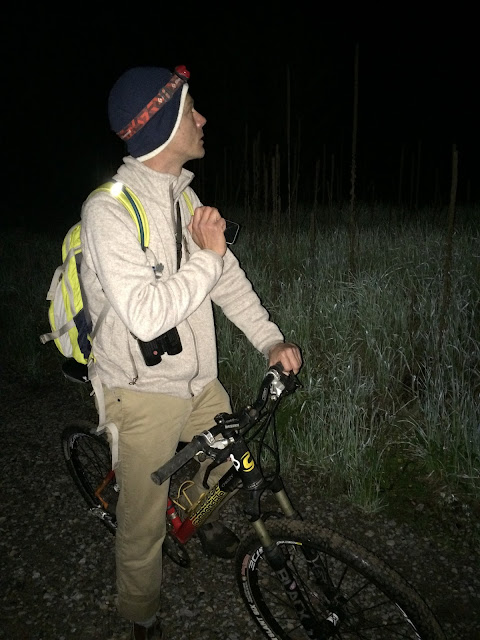
Our first stop of the day, starting at midnight, was owling Green Canyon by bike.  We used the bikes several times during the day, and they ended up being instrumental in allowing us to cover lots of ground efficiently and effectively.

Our first owl of the night was a Flammulated Owl, singing spontaneously at the end of the trail at 12:27 AM.  We also heard a couple of Ruffed Grouse displaying in the dark.  We then focussed on finding Northern Saw-whet Owl and Northern Pygmy-Owl as we biked down, broadcasting song every few hundred meters.  It took more work than expected, but we eventually got one Northern Pygmy-Owl to respond before our 2:00 AM deadline for leaving the canyon.

Our next target was an American Bittern at Bud Phelps WMA, a bird that Andy had found on a scouting trip a couple of weeks earlier.  This one was as easy as they come: we pulled into the parking lot a little before 3:00 AM, and heard it calling almost immediately.  We added a couple other nocturnal vocalizers to our list here, especially Virginia Rail, Sora, and Marsh Wren.  The whole stop was less than ten minutes, and we were off to a stakeout Great Horned Owl.  Our friend Shelly Hatch helped us out by telling us a couple of weeks ago about a pair that had been calling in her yard at night, so we parked quietly in front of her house and played a bit of Great Horned Owl song.  It took a little coaxing, but about five or ten minutes later one called back from a stand of trees near her house.

Next, we wanted to check on some nearby Wood Ducks I had scouted out, a small family group with chicks on a little pond near the Great Horned Owl.  It was too dark to see the ducks at night, but while driving to the pond with the windows down we heard some Barn Owls begging from a barn.  This was a lucky grab as it would later save us about half an hour of daylight birding, allowing us to cut out a scheduled trip to a roosting Barn Owl I had staked out.  With the quick Bittern, Great Horned Owl, and Barn Owl scores in the dark, we had a little time on our hands to look (listen) for Western Screech-Owl, the one lowland owl we hadn't been able to find in our scouting.  We tried a new spot, and again got lucky, with one responding rather quickly to broadcast near the Willow Park Zoo.  A bonus Gray Catbird was singing in the dark, too.  Then, we were off for our first daytime stop ahead of schedule!

Because we had missed Northern Saw-whet Owl in Green Canyon earlier in the night, we were happy to have some time to try for it before sunrise along the road to Tony Grove, where we wanted to be at first light.  We tried many stops along the seven mile road from the highway to the parking area, and finally got lucky just when we were starting to give up hope on that species, as a Northern Saw-whet Owl squealed in response to our broadcast less than a mile from the lake.  By 5:15 AM the sky was already starting to get a bit of color and the dawn chorus was in full swing, so we parked at Tony Grove and worked our way up the trail towards Naomi Peak in search of high-elevation birds.

We started the daylight portion of the day at Tony Grove, the most accessible spot for many of the high elevation specialties of Cache County.

Things started fast at Tony Grove, with singing White-crowned Sparrows, Lincoln's Sparrows, MacGillivray's Warblers, House Wrens, Mountain Chickadees, Dusky and Hammond's Flycatchers, American Robins, Chipping Sparrows, and Fox Sparrows, among others.  We worked our way over some deep snow patches (still frozen solid from the below-freezing nighttime temperatures) and up the trail to the area we call the "first bowl," a glacial cirque that sits just above Tony Grove Lake.  Then, things slowed down a bit.  We had a couple of singing Olive-sided Flycatchers, but were working hard for other high elevation specialties without much luck.  Eventually, some broadcast of White-breasted Nuthatch calls elicited a response, which was a great bird given how limited their distribution is in Cache County: they're found in only in our highest elevation forests, and are patchy and scarce even there.  We heard a Williamson's Sapsucker give its unique long stuttering drum, a great species to pick up given the relatively early date.  After nearly two hours around the area we were still hurting for a lot of common high mountain species, like Brown Creeper, Golden-crowned Kinglet, Steller's Jay, Clark's Nutcracker, Hairy Woodpecker, etc., but had to start heading back to the car.  Then, things started to fall our way.  A Brown Creeper called from a tree for both of us and showed itself to Andy.  A small flock of Clark's Nutcrackers flew down a ridgeline in the distance.  A pair of Hairy Woodpeckers responded to a broadcast call in an area we had both seen the species before.  Even back down at the parking lot as we were loading into the car, a Steller's Jay called in the distance.  I wonder what else we might have found with another half hour there, but a key part of a Big Day is to stay disciplined and stick to your schedule.

Williamson's Sapsucker is a beautiful and distinctive woodpecker of Cache County's highest elevations.  Although a recently-returning migrant, this one was already working a fresh row of sap wells.

White-breasted Nuthatches are very tough to find in Cache County, but the first bowl on the Naomi Peak trail has been a somewhat reliable place to find them in recent years.

By 8:40 AM we were heading down the mountain, with the windows down as always.  This paid off in the form of one more species, our first Orange-crowned Warbler of the day, singing along the road.  As we worked our way quickly down the canyon, we were able to pick up drive-by White-throated Swifts and a Swainson's Thrush.  A planned stop for Chukar and Black-throated Gray Warbler didn't pan out, although we'd pick up the warbler later.  Near the mouth of the canyon we did a short walk for hummingbirds at Stokes Nature Center, but before we even got to the feeders we had seen both of the regular species there, Black-chinned Hummingbird and Broad-tailed Hummingbird, so we took a quick detour for a staked-out American Dipper nest and headed back to the car.  Another quick stakeout stop added a singing Canyon Wren to the list, and then we were out of the canyon and into the lowlands for the rest of the day, starting at First Dam, where a Common Merganser that was present the day before had apparently just left.

American Dippers are common along the high-gradient rivers of Cache County, but having this nest staked out in advance saved us a lot of potential birding time we could have spent just hoping to run into one.
As we passed through downtown Logan on our way to the next stop, we were sure to call out all the common urban species that could be missed in the more wild habitats where we planned to spend the rest of the day: we easily picked up Rock Pigeon and House Sparrow, for example, and were able to hear a singing Lesser Goldfinch through the open car windows.  We started to feel pretty unlucky, missing our second stakeout rarity in a row, when we couldn't find the Great-tailed Grackles at the Logan Landfill.  But, we were disciplined about not sinking too much time into rarities, and quickly continued on to a field where Bobolinks had been displaying in the last couple of weeks.  They showed for us quickly, and we were off to the nearby pond where we hadn't been able to see the Wood Ducks in the dark.  In the daylight, they were easy, and we didn't even stop the car as we drove past in a rush for the next birds.

We had debated whether it was worth it to make our way down to Hyrum Reservoir, and in the end decided there were enough possibilities there to make it worth it.  We were going to get Barn Owl at the east end, but since we had one in the morning and were a bit behind schedule, we skipped the east end and birded only from the west end, where Andy was able to spot a continuing late Common Loon I had found a week or so before.  Within minutes, we were heading back north to Rendezvous Park.  Because this would be our only real lowland "urban" habitat stop, we had a few very familiar species we needed to find, and were actually a bit excited to pick up our Black-capped Chickadee here.  We needed Downy Woodpecker, too, but couldn't find any, even after broadcasting some calls.  

Common Nighthawks arrived just in time for our big day: the one we heard at Tony Grove in the morning was the first reported from Cache County this year.  Here, the second one flies over the Logan Sewage Lagoons in the early afternoon.

It was then around noon, so I asked Andy for a tally so far.  We were both a bit surprised to be at only 80 species, and a bit intimidated with reaching our goal of topping the record of 154 by the end of the day.  But, we hadn't really done much lowland birding yet, and had a lot of sparrows and other dry land birds as well as waterfowl to add to the list; our only ducks so far were Mallard and Wood Duck, for example.  With our next stop, the Logan Sewage Lagoons, the waterfowl numbers climbed quickly.  We got our only Blue-winged Teal of the day here, and focused on other ducks, especially late winter waterfowl like Ring-necked Duck and Bufflehead.  We got our only Belted Kingfisher of the day nearby as we drove to the Logan Polishing Ponds, an extension of the wastewater treatment plant located about a mile to the north.  Here, we picked up many of the expected breeding shorebirds, like American Avocet, Black-necked Stilt, and Willet, along with a great collection of waterfowl including some species that are quite rare this late in the season, especially American Wigeon, Canvasback, Common Goldeneye, and even a continuing Snow Goose I had found a couple weeks earlier that seems to be injured but still healthy.

I first spotted this Snow Goose at the Polishing Ponds a couple of weeks earlier and noted that it was holding its wings in an odd angle.  Although it looked healthy, I think the only reason it was still around is because it was a bit injured.

Canvasbacks have usually all left Cache County before the baby Canada Geese get this big, but this pair was lingering at the Polishing Ponds so that we could count them on our Big Day.
We took a quick detour to Benson Marina for our only Osprey of the day, sitting on a nest, and then drove to Hyde Park Lane.  We cancelled a side trip to look for a stakeout Say's Phoebe after considering that we were a bit behind schedule, the bird was pretty far out of the way, and it hadn't been very reliable in our scouting, only being found once out of three attempts to look for it.  Along Hyde Park Lane, we tried to pick a Glossy Ibis out of the many White-faceds, but with no luck.  We did pick up our first Sandhill Crane of the day here, and our only Wilson's Snipe of the day.

Wilson's Snipe are common in Cache County, but this one on Hyde Park Lane happened to be our only one of the day.
Next up was the Amalga Barrens, usually a great shorebird spot, but we were a bit late for shorebird migration.  Indeed, we didn't have any shorebirds all day that don't breed locally; we were completely too late for passing migrants.  About the best we could do here was to add a pair of Long-billed Curlews and get our first (but not only) Northern Harriers of the day. 

Andy and I worked hard for more shorebirds at the Amalga Barrens, but the best we could do is add a couple of Long-billed Curlews to our list.  We were apparently too late for all the passage migrants.
It was about 4:00 PM, so with a little less than five hours of daylight left and with all the expected shorebirds and waterfowl ticked off, I asked Andy to tally our list again.  We were at 112 species for the day.  When he said this, I did a little mental math and my heart sank.  All those waterfowl and shorebirds, and we only added 32 species?  Five hours left to get 42 species to tie the record?  I started to think about how that could be right.  Andy checked again: yup, 112 species.  When we started Newton Reservoir, I knew it would take a miracle if we were to reach our goal.  

As soon as we pulled up at Newton, we could hear a Yellow-breasted Chat singing, another pretty local species that is tough to find in the valley.  We couldn't find the Blue Grosbeak that had been here last week, but a Golden Eagle flew over (our only one of the day), and a Blue-gray Gnatcatcher called from beneath us in the wash a little while later.  Across the road in the campground area, a Least Flycatcher I had found a few days earlier was singing as we stepped out of the car, and a second one was nearby.  This was probably the rarest bird of the day, at least by some measures, since it was the only one on the review list of the Utah Bird Records Committee.  We broadcast for Downy Woodpecker some more; way too long, I thought, but then, we didn't really have a shot at our goal anyways so it didn't bother me.  We broadcast a bit for Lark Sparrow, and didn't get any responses from that species either.  We needed a miracle to reach our goal, and missing these two easy species wasn't helping.  I was feeling pretty bummed.

On the way to Steel Canyon, Andy added up the numbers again.  I knew we wouldn't be close, but it wasn't going to hurt to hear where we were at, and I was still hoping for my miracle.  And I got it!  Andy realized that he had somehow--twice!--forgotten to count the last page of our six-page checklist.  I don't know how this happened, but I still think he may have been messing with me.  Either that, or the lack of sleep and the 19+ hours of straight birding were hitting both of us pretty hard.  Regardless, heading into Steel Canyon we were actually at 144 species, well within striking range of our goal if things went right!  We picked up singing Vesper Sparrow, Grasshopper Sparrow, and Brewer's Sparrow all from the same spot along the road.  We heard Horned Lark singing a little further along.  We mounted our bikes just as the sky was darkening from a coming storm, and headed into Steel Canyon, some of the best dry juniper forest in the county.


On a Big Day, meals come in the little spaces between birds.  We quickly mounted up and biked the rough road into Steel Canyon as a storm approached.
Steel Canyon went as well as anyone could expect.  First, a Juniper Titmouse sang briefly from the junipers.  Then, a Gray Flycatcher perched on a treetop and wagged its tail downward repeatedly, a distinctive behavior distinguishing this species from half a dozen or more lookalikes.  A Spotted Towhee called from across the canyon, a common species that we just hadn't run into until that point.  Then a pair of Bushtits flew through a clearing, calling in flight and then landing and eventually pausing long enough to give me a quick look through binoculars.  The rain started as Andy broadcast Black-throated Gray Warbler and Plumbeous Vireo at a spot he had heard both species recently.  A Plumbeous Vireo flew into view and started singing in response, and a minute or so later, a Black-throated Gray Warbler started singing in the rain.  We would later calculate that with these two species, we tied and then broke the Cache County Big Day record!

Biking back down to the car in the rain from Steel Canyon, with six new species on our list and a new Cache County Big Day record.

After a quick bike back down to the car, we headed to another nearby road where Andy had recently had Short-eared Owls at dusk.  This is not a rare species in the county, but they tend to be most active at dawn and dusk, and we hadn't had them yet.  His spot worked like a charm, and within minutes four Short-eared Owls were flying all around us, species #156 for the day.

Two of four Short-eared Owls that put on a show for us at dusk on Sink Creek Road.
We were short on daylight, but also short on reasonable species we needed for the day.  We headed to Bear River Bottoms WMA at sunset in a last-ditch attempt at our biggest miss of the day, but we wouldn't find Downy Woodpecker there either.  We tried Cherry Creek again for Downy Woodpecker as the sky got darker, and then a little further up for Dusky Grouse, but didn't find either of those.  By the time we were done there, it was nearly 10:00 PM and we were both getting quite tired.  We tried following up on a tip for Long-eared Owl at Benson Marina, without any luck.  Some fireworks in the distance seemed to be both celebrating our huge day, and telling us it was time to be done.  At about 11:00 PM, we had few options for new birds left, and even less energy to look for them, so we called it a day.  We went to bed tired, happy, and satisfied, with a new Cache County Big Day record in the books: 156 species, topping the old record of 154 that had been set in 1988!

Andy heads into a stand of trees for a last-minute attempt at Downy Woodpecker as the sun set.

Here is our complete list of species for the day:
Snow Goose
Canada Goose
Wood Duck
Gadwall
American Wigeon
Mallard
Blue-winged Teal
Cinnamon Teal
Northern Shoveler
Northern Pintail
Green-winged Teal
Canvasback
Redhead
Ring-necked Duck
Lesser Scaup
Bufflehead
Common Goldeneye
Ruddy Duck
Ring-necked Pheasant
Ruffed Grouse
Common Loon
Pied-billed Grebe
Eared Grebe
Western Grebe
Clark's Grebe
Double-crested Cormorant
American White Pelican
American Bittern
Great Blue Heron
Snowy Egret
Cattle Egret
Black-crowned Night-Heron
White-faced Ibis
Turkey Vulture
Osprey
Golden Eagle
Northern Harrier
Swainson's Hawk
Red-tailed Hawk
Virginia Rail
Sora
American Coot
Sandhill Crane
Black-necked Stilt
American Avocet
Killdeer
Spotted Sandpiper
Willet
Long-billed Curlew
Wilson's Snipe
Wilson's Phalarope
Bonaparte's Gull
Franklin's Gull
Ring-billed Gull
California Gull
Caspian Tern
Forster's Tern
Rock Pigeon
Eurasian Collared-Dove
Mourning Dove
Barn Owl
Flammulated Owl
Western Screech-Owl
Great Horned Owl
Northern Pygmy-Owl
Short-eared Owl
Northern Saw-whet Owl
Common Nighthawk
Common Poorwill
White-throated Swift
Black-chinned Hummingbird
Broad-tailed Hummingbird
Belted Kingfisher
Williamson's Sapsucker
Red-naped Sapsucker
Hairy Woodpecker
Northern Flicker
American Kestrel
Olive-sided Flycatcher
Western Wood-Pewee
Least Flycatcher
Hammond's Flycatcher
Gray Flycatcher
Dusky Flycatcher
Western Kingbird
Eastern Kingbird
Plumbeous Vireo
Warbling Vireo
Steller's Jay
Black-billed Magpie
Clark's Nutcracker
American Crow
Common Raven
Horned Lark
Northern Rough-winged Swallow
Tree Swallow
Violet-green Swallow
Bank Swallow
Barn Swallow
Cliff Swallow
Black-capped Chickadee
Mountain Chickadee
Juniper Titmouse
Bushtit
Red-breasted Nuthatch
White-breasted Nuthatch
Brown Creeper
Canyon Wren
House Wren
Marsh Wren
Blue-gray Gnatcatcher
American Dipper
Ruby-crowned Kinglet
Mountain Bluebird
Townsend's Solitaire
Swainson's Thrush
Hermit Thrush
American Robin
Gray Catbird
European Starling
Cedar Waxwing
Orange-crowned Warbler
MacGillivray's Warbler
Common Yellowthroat
Yellow Warbler
Yellow-rumped Warbler
Black-throated Gray Warbler
Yellow-breasted Chat
Green-tailed Towhee
Spotted Towhee
Chipping Sparrow
Brewer's Sparrow
Vesper Sparrow
Savannah Sparrow
Grasshopper Sparrow
Fox Sparrow
Song Sparrow
Lincoln's Sparrow
White-crowned Sparrow
Dark-eyed Junco
Western Tanager
Black-headed Grosbeak
Lazuli Bunting
Bobolink
Red-winged Blackbird
Western Meadowlark
Yellow-headed Blackbird
Brewer's Blackbird
Brown-headed Cowbird
Bullock's Oriole
House Finch
Cassin's Finch
Pine Siskin
Lesser Goldfinch
American Goldfinch
House Sparrow